Which Anxiety Condition Matches Your Symptoms?
Anxiety rarely announces itself the same way twice. For some people, it’s a racing heart before a phone call. For others, it’s checking the stove five times before leaving the house, or rehearsing a conversation for hours before it even happens. As an anxiety coach in Oregon, I’ve learned that generalized anxiety, social anxiety, panic disorder, and OCD each pull on a different thread, even though they can tangle together in the same person.
Panic disorder coaching often starts with a client describing a moment that felt like dying, even though nothing was physically wrong. Social anxiety shows up differently, a dread that builds hours before walking into a room full of people. OCD adds its own weight, intrusive thoughts followed by rituals meant to quiet them.
None of this makes you fragile. It makes you someone whose mind is working overtime to protect you from something that may not need protecting against.
Common Struggles I Help Clients Work Through Together
Every anxious mind runs its own loop. Some clients arrive mid-panic attack territory. Others have quietly avoided rooms, phones, or people for years. Coaching starts by naming the pattern.
- Racing thoughts that won't slow down
- Physical panic symptoms with no clear cause
- Avoiding social situations out of dread
- Intrusive thoughts that repeat on a loop
- Compulsive checking, counting, or ordering behaviors
- Constant worry about things outside your control
- Fear of specific places, objects, or situations
- Trouble concentrating because worry crowds everything out
- Physical tension that never fully releases
- Overthinking conversations long after they've ended
- Anticipatory dread before ordinary daily tasks
- Feeling exhausted from a mind that won't rest
What Grounds My Work With Anxious Clients
An autism evaluation uses evidence-based measures and typically includes:
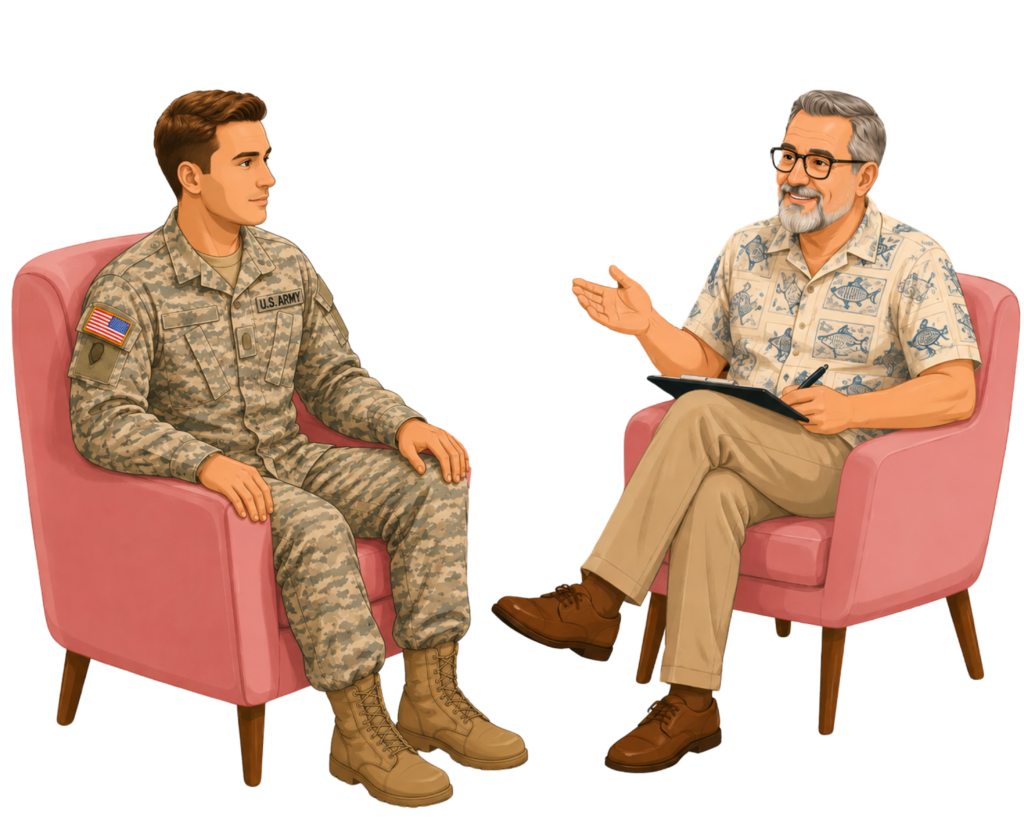
I work with civilians, veterans, and everyone in between. Anxiety doesn’t check a background before it takes hold, and neither do I when someone reaches out for help. My approach leans on contemplative coaching, staying fully present with you rather than rushing toward a fix. Anxiety often needs to be understood before it can be managed, and understanding takes patience, not a checklist of techniques applied too quickly.
- Contemplative coaching, not rigid technique-based sessions
- Open to clients from any background
- Practical grounding tools for panic moments
- Space to talk through OCD without shame
- Support for social anxiety at any severity
- Faith-informed reflection available if you want it
- Flexible scheduling around phobia-related limitations
CD coaching works best when nobody treats your rituals as strange. I’ve sat with enough anxious minds to know the compulsion always makes sense from inside it.
What Actually Happens in Our Sessions
Growing Prevalence and the Power of Early Intervention
Our first session usually starts with a simple question: like what does a hard day actually look like for you? From there, I listen for patterns rather than jumping straight to solutions. Some clients want tools right away: breathing techniques, grounding exercises, ways to interrupt a spiral. Others need to talk through the anxiety itself before anything practical makes sense.
Coaching isn’t a substitute for treatment if your anxiety needs clinical attention, and I’ll tell you plainly if that’s the case. What I offer is a steady, judgment-free space to work through what’s happening and build a workable plan for your week.